He conceived of a factory line of people and machines working in close choreography to make cars affordable for the masses.
More than a century later, Ford’s moving assembly line looks quaint compared with a fully robotic factory in northeast China, where cars made by manufacturer Zeekr roll off the production line without a human hand touching them. The factory, which can churn out 300,000 cars a year, is an example of a dark factory – sometimes called lights-out manufacturing – in which no humans are present or robots far outnumber people. The goal is improved productivity and dependability, and less downtime.
The International Federation of Robotics (IFR) says global robot density continues to break new records. There were around 162 robots for every 10,000 employees in businesses in 2023, more than double the level measured seven years earlier. And in 2024 and 2025, the rise of the robots has been even clearer. The IFR counted more than 4.6 million industrial robots operating in factories worldwide in 2024, up 9% from around 4.28 million the year before.
The pace is picking up because AI is changing what can be automated. Better machine vision and cheaper sensors help robots handle the messiness of real-world factories, and simulation and digital twin tech can make business owners feel more confident in how they roll them out. Variations of generative AI – the tech powering the likes of ChatGPT – help reduce issues that arise when robots are let loose by themselves.
But if humans are absent, engineering has to compensate with even more reliability, redundancy, diagnostics, cybersecurity and quality control. Without humans involved, a dark factory can go off the rails quickly – or become an attractive target for mischief makers.
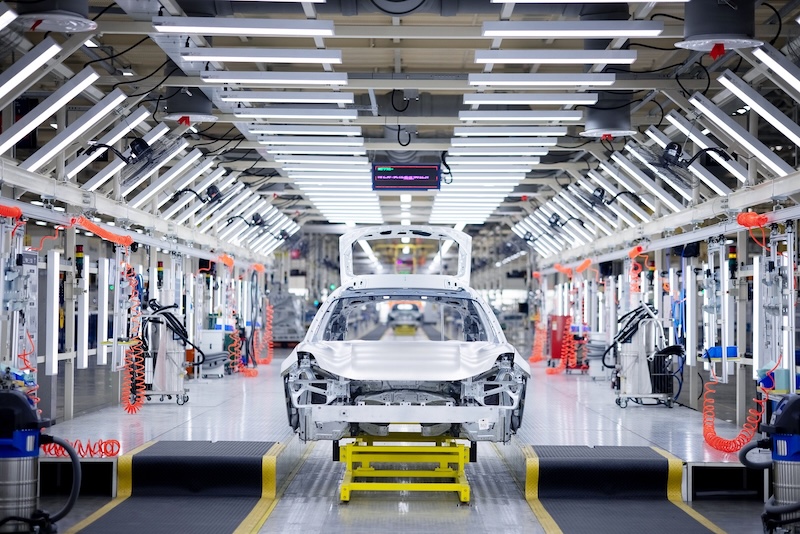
A fully robotic factory in northeast China, where cars made by manufacturer Zeekr roll off the production line without a human hand touching them
Evolution, not revolution
Dark factories are a continuation of increasing automation since the Industrial Revolution, rather than a massive rupture, reckons Richard Anderson, technical director at engineering consulting firm WSP. “The move toward dark factories is really an extension of a long automation journey, rather than a sudden shift,” he says. “Rising labour costs, safety expectations and quality requirements have steadily reduced reliance on manual labour for more than a century.”
Anderson calls dark factories “the next logical and positive evolution” of that trend, promising “safer, more efficient and more resilient manufacturing environments”. But he’s quick to point out that reliability, resilience and maintenance are all major challenges for engineers to solve. “Routine maintenance is increasingly automated, but reactive and preventative maintenance remain highly dependent on skilled human technicians,” he says. “These roles are becoming more technical and diagnostic, and while AI tools are improving, they don’t yet fully replicate that capability.” In other words: you can automate production, but you still have to engineer for the reality: things break.
The push towards removing humans from factory floors comes with its own issues. While humans can’t work as quickly as robots, they are better at finding issues when things go wrong. Humans can hear a malfunctioning machine or smell an overheated motor better than robots ever could. Replicating that human intuition through instrumentation is tricky. This means that redundancy becomes more important in dark factories. If a robot fails in a line alongside humans, an operator can sometimes work around it. If a robot fails in a fully automated process, the line may stop entirely.
This issue is why lights-out factories are often actually lights-dimmed ones: automation is brilliant at doing the same thing repeatedly, but gets much worse at noticing when that same thing has drifted. “Highly automated, high-throughput systems can produce defects very quickly if faults aren’t contained,” warns Anderson. “Without strong controls and validation processes, the risk of large-scale wastage increases.”
Even those away from the front line of tech development know now that robots can pick, place, weld and assemble items as well, if not better, than humans. But dark factories remain few and far between because of what happens when something goes wrong, whether it’s a slightly warped part, a supplier substitution, a new variant or a tool that wears differently than expected.
What that means for engineering is that factories are more likely to require fewer workers, but those that remain will be more specialised. Anderson expects to see “the number of operators reducing” but says “the roles that remain will be more strategic, specialised and focused on managing larger, more complex facilities, rather than performing repetitive tasks”.
Cybersecurity concerns
That includes cyber experts because dark factories rely hugely on their connectivity. Robots talk to internal IT systems and to external processes. That’s what makes dark factories tick, but it is also what makes them a potential playground for hackers.
Andrew Ginter, vice president of industrial security at Waterfall Security Solutions, a security firm focused on the risks to industry from cyberattacks, argues that with every human removed from the factory floor, the security conversation needs to become more and more serious. Shorn of human sight, in a lights-out environment, attackers can steal more than data. They can halt production and corrupt the quality of what is coming out of factories.
“Attack information enters the networks,” Ginter says. “An attack can come in via a firewall, through a USB key, in my head, in an engineer’s head. It can come in lots of ways.”
Even when a plant believes it is isolated, there are usually ways in, even in dark factories. Contractor laptops, temporary remote access, USB updates and engineering workstations are all potential vectors. And, unlike human-filled factories, where access is strictly limited to people who visit the premises, dark factories tend to increase the number of potential vulnerabilities because most people log in through remote support and remote visibility.
The impact of such hacks can be huge. Jaguar Land Rover reported a £196m hit from a cyber incident that disrupted production in 2025, with broader estimates putting the wider economic impact far higher. A cyberattack on Norsk Hydro in 2019 using ransomware forced parts of its operations into manual mode, costing the firm around $70m.
Engineering factories to the point of working well often conjures up tweaks to processes and machinery, but in dark factories the operational risk comes as much from cyber as anything else.
Staying secure
Staying secure in this environment is therefore vital. But the novelty of dark factories makes it hard to understand what good looks like.
Ginter suggests that a few broad principles can keep things relatively safe. The first is segmenting off processes so that not everything needs to talk to everything else. The IEC 62443 family of standards suggests engineers keep “zones and conduits” separate to stay safe. In the US, the National Institute of Standards and Security also suggests a risk-based architecture including asset inventorying, access control and monitoring.
Controlling who has remote access is the second key consideration when thinking about dark factories. The temptation is to give vendors always-on access to keep production and utilisation high. After all, what’s the point of having a factory where humans cannot limit output if you are going to limit the output to waking hours? But staying safer and limiting access is the better option. Having strong identity controls, multi-factor authentication and careful logging of who has access to what is crucial – plus patience that the factory is not going to work all hours if it cannot be done safely.
Recognising that things likely will go wrong, and that a cyberattack will be launched, is also important, reckons Ginter, who believes some organisations still rely too heavily on conventional attempts to control access. Firewalls don’t always work, he explains. “You’re putting very smart, very patient people up against a piece of software.” His argument is that engineering should focus on eliminating certain types of remote attack, such as limiting the ability of external networks to send commands into critical environments.
Why dark factories still need humans
The goal of a dark factory is that it can tick along without any oversight. But the more these types of facilities roll out around the world, the more we are starting to realise that dark factories still need people – just not necessarily on the factory front line, and not necessarily all the time.
Humans are still needed to help design and validate the processes within factories, and to step in when the equipment breaks or buckles – which it will do more often because of less downtime. And where humans are in the minority, dark factories seem to achieve their best results through high-volume, low-variation production, churning out the same old items.
All that may make dark factories seem like more hassle than they’re worth. But that’s not the case, experts say. “At present, the benefits clearly outweigh the downsides,” says Anderson. “Automation supported by AI is delivering higher productivity, improved quality, better safety and more cost-effective operations. The issues we encounter tend to be manageable challenges, rather than fundamental barriers, and most can be resolved as the technology matures.”
However, we’ll still need people around “for quite some time,” he says. “Even as automation increases, humans remain essential to improving systems, diagnosing complex issues and driving changes that enhance quality and safety.”
The promise of dark factories is obvious. You can have higher utilisation, lower labour costs, fewer safety incidents and more consistent quality. Yet the risk is equally enormous: a single point of failure can halt the entire system, and cyber threats that used to be IT problems become events that stop production and tank business bottom lines. This is why engineering prowess and insight are still needed to make them safe, as well as efficient and effective. When production depends on software, networks and autonomous systems, the factory itself becomes a complex engineered product of its own – and like any engineered product, it’s doomed to struggle unless you design for failure.
Where dark factories already exist – and what they can teach us
Dark factories may sound like science fiction, but in some parts of the world they’re science fact. Here’s where they work today.
FANUC, Oshino (Japan)
FANUC’s robotics facilities are often cited as the Platonic ideal of a dark factory. At these sites robots build robots, and operations have been reported as running unattended for long stretches. Production can reportedly run unsupervised for as long as 30 days at a time.
Siemens, Amberg Electronics Plant (Germany)
Siemens uses its Amberg plant as a showcase for deep automation, although it is not quite a dark factory in the true sense of the word because robots work alongside humans. Siemens claims Amberg has production quality of 99.9988%.
Xiaomi, Changping factory (China)
An 860,000 sq ft facility overseen by smartphone manufacturer Xiaomi includes 11 fully automated production lines capable of producing a single smartphone every three seconds, powered by the company’s Pengpai Intelligent Manufacturing Platform.
Beyond these examples of fully lights-out factories that can run for full days autonomously, there are a range of smaller sections within larger factories that run without human oversight overnight, on weekends or for other short periods of time. These include high-volume CNC machining for making tools or other objects, as well as some semiconductor manufacturing plants because involving humans too closely risks contaminating the devices, which can easily fail if they come into contact with dust or grease. Some carmakers now also run automated body shops and paint shops with fewer people present for the final assembly of a vehicle.
Want the best engineering stories delivered straight to your inbox? The Professional Engineering newsletter gives you vital updates on the most cutting-edge engineering and exciting new job opportunities. To sign up, click here.
Content published by Professional Engineering does not necessarily represent the views of the Institution of Mechanical Engineers.